
Tuesday, August 23, 2011

QUANTUM PHYSICS


Quantum Physics is the science of things so small that the quantum nature of reality has an effect. Quantum means 'discrete amount' or 'portion'. Max Planck discovered in 1900 that you couldn't get smaller than a certain minimum amount of anything. This minimum amount is now called the Planck unit. With this set of principles underlying the most fundamental known description of all physical systems at the subatomic level and provides accurate descriptions for many previously unexplained phenomena also given insight into the workings of many different biological systems.
Ultimately, and most importantly, I believe it describes the nature of the universe as being much different then the world we see.

Niels Bohr, the father of the orthodox 'Copenhagen Interpretation' of quantum physics once said, "Anyone who is not shocked by quantum theory has not understood it".

For beginners, I suggest you get aquainted with these experiments: Two Slits,

Two Slits
The simplest experiment to demonstrate quantum weirdness involves shining a light through two parallel slits and looking at the screen. It can be shown that a single photon (particle of light) can interfere with itself, as if it travelled through both slits at once.


Sumber: http://phoenixaquua.blogspot.com

Sunday, July 24, 2011

MATAHARI MEMASUKI FASA SEPERTI ABAD KE-17

WASHINGTON - Saintis-saintis Amerika Syarikat (AS) menyatakan kitaran biasa bintik matahari kini memasuki fasa hibernasi yang tidak pernah dilihat sejak kurun ke-17 dengan suhu global dijangka turun akibat perubahan itu.
Selama bertahun-tahun, para saintis meramalkan bahawa menjelang 2012, matahari akan mengalami fasa dikenali sebagai solar maksimum dengan aktiviti ledakan api dan bintik matahari berada pada tahap paling aktif.
Keadaan tersebut dijangka menyebabkan suhu Bumi meningkat.
Namun, permukaan matahari yang agak tenang sejak kebelakangan ini menunjukkan keadaan yang sebaliknya.
Tanda-tanda perubahan tersebut termasuk ketiadaan pancutan api, sejumlah bintik yang pudar dan kelembapan aktiviti di kedua-dua kutub matahari.
Pendedahan itu dibuat menerusi tiga hasil kajian yang dibentangkan pada pertemuan tahunan Bahagian Solar Fizik Persatuan Astronomi Amerika Syarikat di Las Cruces, negeri New Mexico kelmarin.
"Keadaan ini ganjil dan di luar jangkaan," kata seorang pengarah bersama Agensi Percerapan Solar Nasional, Frank Hill.
Aktiviti matahari cenderung meningkat dan berkurangan setiap kitaran 11 tahun.
Fasa solar maksimum dan solar minimum pula berlaku setiap 22 tahun. - AFP

Thursday, June 9, 2011

LETUSAN SUAR MATAHARI TERBESAR 7 JUN 2011


Solar Flare Sparks Biggest Eruption Ever Seen on Sun
Enormous ejection of particles into space shocks scientists.
Main Content
A solar flare on June 7, 2011.
A solar flare created a spectacular eruption on June 7 (pictured).

Image courtesy SDO/NASA

Dave Mosher

for National Geographic News

Published June 8, 2011

A mushroom of cooled plasma popped like a pimple and rained onto the surface of the sun yesterday—shooting perhaps the largest amount of solar material into space ever seen, scientists say.

(Watch a video of the solar flare.)

The solar flare—an unusually bright spot on the sun—wasn't surprising as a "moderate" event. Space observatories in the past year recorded about 70 such solar flares, each roughly ten times weaker than "extreme" flares, of which only two have occurred since 2007.

(Related: "Biggest Solar Flare in Years—Auroras to Be Widespread Tonight?")

Instead, what shocked scientists was the unusual amount of material that lofted up, expanded, and fell back down over roughly half the surface area of the sun. The event's simultaneous launch of particles into space is called a coronal mass ejection (CME).

"This totally caught us by surprise. There wasn't much going on with this spot, but as it came from behind the sun, all of the sudden there was a flare and huge ejection of particles," said astrophysicist Phillip Chamberlin of NASA's Solar Dynamics Observatory (SDO), one of several spacecraft that recorded the event.

"We've never seen a CME this enormous."

(See pictures of solar eruptions.)

Solar Flares May Threaten Power Grids

Chamberlin said it will take some time to calculate the energy and mass of electrons and protons blasted into space. But he noted the volume occupied a space hundreds of times bigger than a single Earth.

The ejection of particles burst from the right limb of the sun and sprayed into space, so the blast will miss Earth—though the explosion may brighten auroras near Earth's poles, Chamberlin said.

(See pictures of auroras generated by the Valentine's Day solar flare.)

But he warned space-weather experts are concerned about future solar events.

The sun's 11-year cycle of activity, driven by tangled surface magnetic fields, will hit its maximum in late 2013 or early 2014. Magnetic messiness will peak around that time and prompt nasty solar storms.

"We'll probably see [extreme] flares every couple of months instead of years," Chamberlin said.

If one of these powerful flares—and its coronal mass ejection—faces Earth, the particles will pound satellite components with charged particles, short some out, and potentially cripple them.

On the planet's surface, extra currents of solar particles drive extra electric current through power lines and heat them up. A solar storm in 1859, for example, caused telegraph lines to burst into flames. Power companies distribute loads to avoid such a disaster, but energetic solar storms could still blow transformers and lead to power outages, especially during heat waves like the one sweeping the eastern U.S. this week.

"Despite great countermeasures, the power grid is still vulnerable. We could be in for some serious problems," Chamberlin said.

SUMBER:
http://news.nationalgeographic.com/n...rflareeruption


Wednesday, May 11, 2011

6.1 TRANSVERSE AND LONGITUDINAL WAVE

TRANSVERSE WAVE
Imagine a cork on a pond. Waves make the cork bob up an down but it doesn't move in the direction the wave is going. Light waves vibrate similarly, up and down and also from side to side, while the light energy moves forward. This is the characteristic of Transverse wave.


A Transverse Wave is a wave in which
particles of the medium move in a direction perpendicular to the direction which the wave moves. The animation below shows a one-dimensional transverse plane wave propagating from left to right. The particles do not move along with the wave; they simply oscillate up and down about their individual equilibrium positions as the wave passes by. Pick a single particle and watch its motion.

  • Transverse waves are mechanical waves. That means they need a solid, liquid, or gas medium to travel through.
  • Transverse waves include all electromagnetic (radio wave, microwave, Infra Red, visible light, ultra violet., X-rays and Gamma rays)


LONGITUDINAL WAVE
  • A longitudinal wave is a wave in which particles of the medium move in a direction parallel to the direction which the wave moves.
  • Example: Sound waves


Tuesday, May 10, 2011

6.1 WAVEFRONT, AMPLITUDE, PERIOD AND FREQUENCY

WAVEFRONT
A line of surface which joins all points which have the same displacement at the same moment (they are all in phase).


The perpendicular distance between two wavefronts represents one wavelength.


Plane wavefront & Circular wavefront

Amplitudes
  • The distance from the maximum displacement to the equillibrium position is called the Amplitudes, a.
  • SI unit : meter, m
  • Loud sounds have a large amplitude.
  • Brightness in light have a large amplitude.
Wavelength
The distance between two adjacent point of the same phase of waves.


  • The times taken for the system make a complete oscillation is known as Period, T.
  • The number of complete oscillations made by a system in one second is called frequency, f.


The relationship between wavelength, frequency and speed of wave is:


Displacement-time graph


Displacement-distance graph

Monday, May 9, 2011

6.1 DAMPING & RESONANCE

DAMPING
  • Damping is the decrease in the amplitude of an oscillating system when its energy is drained out as heat energy.
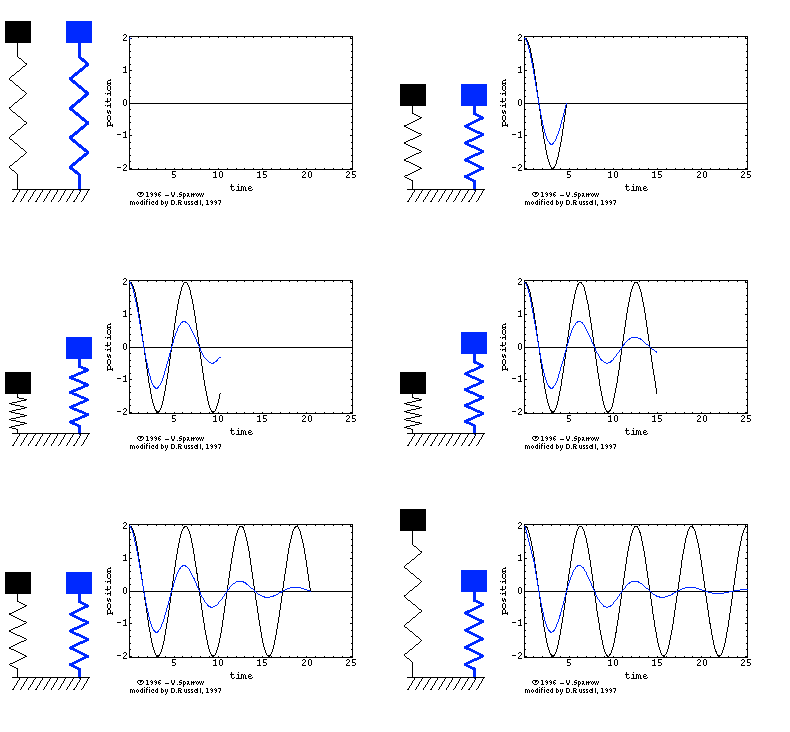
  • The amplitude of an oscillating system will gradually decrease and become zero when the oscillation stops.
  • Damping causes a decrease in amplitude and energy but the frequency of the oscillation remain unchanged.


In the diagram on the right the blue spring is
experiencing damping but not the black spring. take note of the decrease in amplitude but the frequency is the same. The initial amplitude was 2 unit and it was decreasing. But the frequency remains as 4 complete oscillations in 25 s (0.16 Hz).

There are two types of damping: External Damping and Internal Damping.

1. External Damping
  • Is lost of energy to overcome frictional force or air resistance.

2. Internal Damping
  • Is due to compression and extension of atoms and molecules of the system.

To enable an oscillating system to go on continuously, an external force must be applied to the system.
  • The external force supplies energy to the system.
  • Such a motion is called a forced oscillation.

The frequency of a system which oscillates freely without the action of an external force is called the natural frequency.


Application of damping in our daily lives

Vehicle suspension system. A vehicle spring and shock absorber system provides damping to prevent the vehicle from bouncing up and down continuously.


How car suspension work.


RESONANCE
  • Occurs when a system/matter oscillate at a frequency equivalent to its natural frequency by an external force.
  • Due to resonance, particle/matter oscillate at a higher amplitude.


In the Barton's pendulum on the right when pendulum X was oscillated it supplied energy to the other pendulums making them oscillate. It was observed that pendulum C oscillates with the largest amplitude. This is because pendulum X and pendulum C have the same pendulum length. The natural frequency of an oscillating system depends on its pendulum length. Therefore pendulum X and pendulum C are of the same natural frequency. Hence pendulum C is at resonance.

Video clip for Resonance


Good effects of Resonance in our daily lives

  1. A tuner in the radio or television enables you to select the channel we want. Te circuit in the tuner is adjusted until resonance is achieved, at the frequency transmitted by a particular station selected. Hence a strong electrical signal is produced.
  2. The loudness of a wind musical instrument like trumpet and flute is the result of resonance of the air.

Bad effects of Resonance in our daily lives
  1. A bridge may collapse when the amplitude of its vibration increases because of resonance. The action of the wind can cause the bridge to vibrate with a large amplitude as a result of resonance
  2. The loud explosion can cause a glass window to break
  3. The high pitch note of an opera singer can cause a thin glass to shatter